
Unicode Encoder / Decoder
Encode or decode Unicode escape sequences.
Type to search tools. Use the up and down arrow keys to move through results, Enter to open a result, and Escape to clear the search.
Encode or decode Unicode escape sequences.
Related tools
Ready tools are shown first.
Tool guide
Free Online Unicode Encoder / Decoder
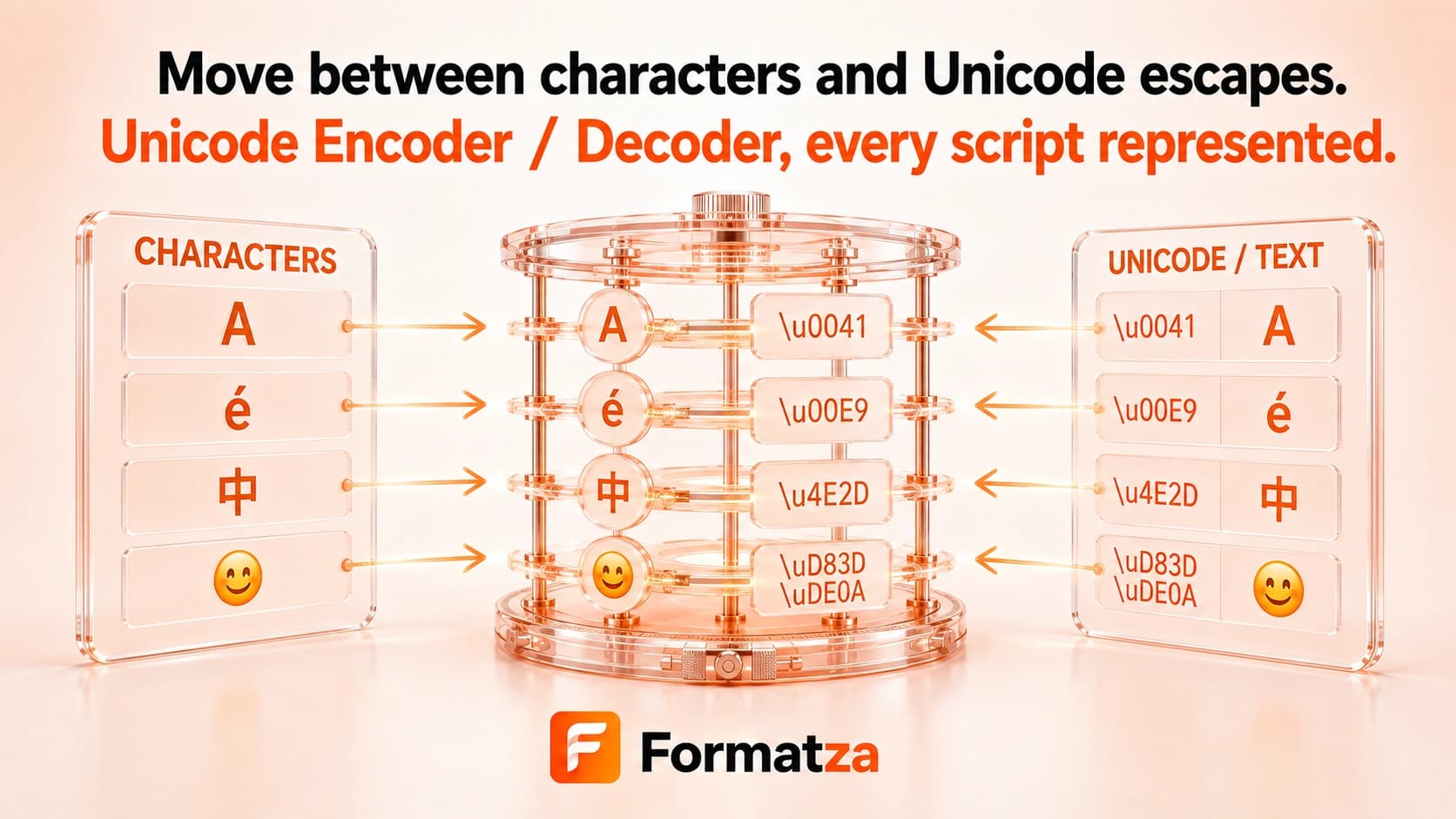
Convert text into Unicode escape sequences or decode recognized escapes back into text. BMP code points use JavaScript-style \uXXXX output, while emoji and other supplementary code points use braced \u{...} escapes.
Steps
How it works
- Choose Text to Unicode or Unicode to Text.
- Enter text, or paste supported \uXXXX and \u{...} escape sequences.
- Convert Unicode code points without executing the string.
- Copy or download the converted output.
Highlights
Key features
- Iterates text by Unicode code point rather than splitting supplementary characters into separate surrogate halves.
- Emits uppercase hexadecimal digits in \uXXXX or \u{...} syntax.
- Decodes exactly four-digit \uXXXX escapes and braced hexadecimal code-point escapes.
- Supports emoji and non-Latin text with the braced syntax.
- Preserves ordinary text and unrecognized escape syntax during decoding.
- Provides plain-text file input, copy, and download actions.
Use cases
Common uses
- Create Unicode escape examples for source code or documentation.
- Decode escaped API or configuration text.
- Inspect code points used by emoji and non-Latin characters.
- Compare visible text with its Unicode escape representation.
Notes
Limitations to know
- The tool uses code-point escapes; it does not display UTF-8 bytes or numeric U+XXXX labels.
- Supplementary characters are emitted as \u{...}, not as JavaScript surrogate-pair \uXXXX\uXXXX sequences.
- Only four-digit and braced \u escapes are decoded; other escape formats remain unchanged.
- Unicode normalization is not performed, so combining sequences remain separate code points.
- Malformed unrecognized escapes may remain as typed, while out-of-range recognized code points fail.
FAQ
Frequently asked questions
Which Unicode escape format does the tool use?
BMP code points use \uXXXX, while values above U+FFFF use braced \u{...} syntax.
Are emoji supported?
Yes. Emoji and other supplementary characters are encoded as braced code-point escapes.
Does it generate JavaScript surrogate pairs?
No. Supplementary code points use one \u{...} escape instead of two \uXXXX surrogate escapes.
Is Unicode the same as UTF-8?
No. Unicode assigns code points, while UTF-8 is one byte encoding for those code points.
Are combining characters preserved?
Yes. They remain distinct code points because the tool does not normalize Unicode text.
What happens to unsupported escape syntax?
Only recognized \uXXXX and \u{...} patterns are replaced; other text generally remains unchanged.