
SQL Formatter
Format SQL queries for readability.
Type to search tools. Use the up and down arrow keys to move through results, Enter to open a result, and Escape to clear the search.
Format SQL queries for readability.
Related tools
Ready tools are shown first.
Tool guide
Free Online SQL Formatter
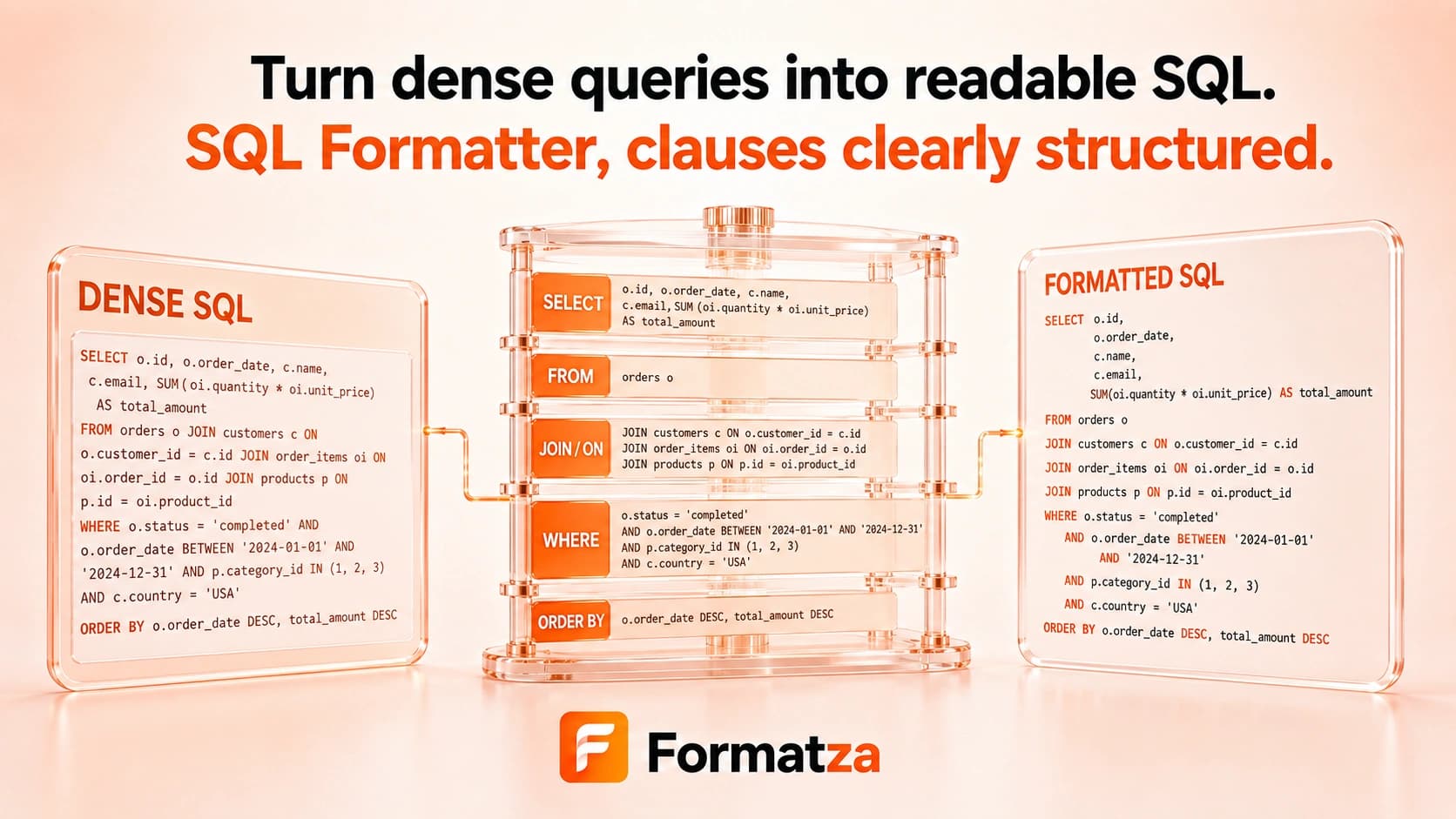
Add line breaks around common SQL clauses, commas, AND, and OR to make straightforward queries easier to scan. This lightweight formatter is dialect-neutral and regex-based; it does not parse, validate, execute, or optimize SQL.
Steps
How it works
- Paste SQL or choose one SQL or TXT file.
- Run the formatter to normalize whitespace and split supported clauses.
- Review the query carefully, especially strings, comments, and vendor-specific syntax.
- Copy the result or download a formatted SQL file.
Highlights
Key features
- Recognizes common clauses such as SELECT, FROM, WHERE, JOIN, GROUP BY, ORDER BY, INSERT INTO, UPDATE, and DELETE FROM.
- Places comma-separated items and AND or OR conditions on indented lines.
- Handles pasted SQL and supported SQL or TXT files.
- Preserves the existing letter case of matched SQL keywords.
- Provides copy and SQL download actions.
Use cases
Common uses
- Make a straightforward SELECT query easier to review.
- Split common joins and conditions across readable lines.
- Clean up simple SQL copied from logs or application code.
- Prepare a query for documentation or a code review.
Notes
Limitations to know
- There is no dialect selector; PostgreSQL, MySQL, SQL Server, SQLite, Oracle, and other vendor syntax are not parsed separately.
- Formatting is regex-based and normalizes whitespace globally, including content that may be meaningful inside strings or comments.
- Nested queries, CTEs, stored procedures, template placeholders, complex expressions, and multiple statements are not syntax-aware.
- The formatter does not validate SQL, execute queries, connect to a database, detect injection, or optimize performance.
- There are no options for keyword capitalization, comma style, or indentation width.
FAQ
Frequently asked questions
Which SQL dialects are supported?
No specific dialect is selected or parsed. The formatter recognizes a limited set of common SQL keywords with text rules.
Does SQL Formatter validate or execute queries?
No. It only changes text layout and cannot confirm syntax, results, permissions, or database behavior.
Can it format multiple SQL statements?
Multiple statements may receive some line breaks, but statement boundaries and dialect-specific grammar are not parsed.
Are SQL comments preserved?
Comment text is not intentionally removed, but global whitespace normalization may change it and syntax-like words inside comments can be reformatted.
Can it uppercase SQL keywords?
No. The current formatter preserves the case of matched text rather than applying a capitalization option.
Does formatting optimize query performance?
No. Query planning, indexes, data distribution, and database execution are outside this text formatter.